How Jennic Created the World Speed Record for the Industry Benchmark Goal of Full Bluetooth Compliance
People often ask me does your methodology actually work? The resounding answer is, Yes. Based on decades of experience and deep insight into methodology, I can easily make that prediction. Around 90% of high-tech companies have a sub-optimal PM system. An organisation with an optimised Project Management System, can deliver 10 to 20% faster and cheaper than the average company. It can be difficult to measure the actual improvement on a specific project, that is, the measurable improvement. On a single project you either get a sub-optimal performance or an optimised performance, but not both. On the other hand, schedule and budget overruns are commonly observed.

Benchmarks in project execution speed are difficult to find. Perhaps by far the best benchmark is the development of the world’s first Bluetooth solutions. This is because so many competitors were pursuing the same goal - the start and end points were identical.
The Bluetooth communications protocol was originally developed by Ericsson Mobile Phones in Sweden in 1998. Five companies that formed the original Bluetooth Special Interest Group (SIG) in 1998:
Ericsson
IBM
Intel
Nokia
Toshiba
The aim was to make BT a universal, de-facto standard, rather than a proprietary standard.

Coincidently I was a project manager at VLSI Technology Inc., who were the strategy development partner for all of Ericsson’s system-on-chip development solutions. I was the project manager for the world’s first BT communication chips in 1999 - 2000. This was the world’s very first silicon solution, but by no means the last.
Bluetooth was developed to be a ubiquitous ad-hoc, short-range communication solution. Today, more than 35,000 companies are now members of the Bluetooth SIG and can develop Bluetooth-based solutions and products. The dream has become a reality.
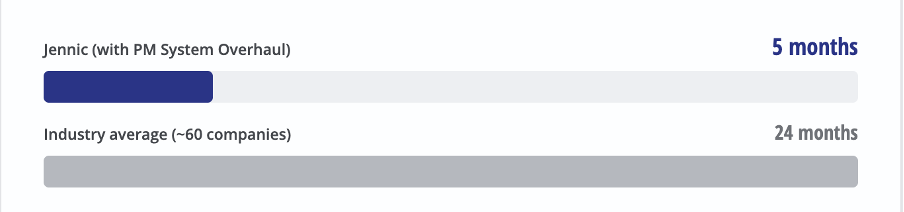
In my next company, Jennic, I was Engineering Programme Manager. I was responsible for the methodology, processes and delivery capability of the company. Within Jennic, together with technical heads for each engineering discipline, I developed a structured PM system (PMS) and Product Development Lifecycle (PDLC). These were highly optimised for speed and right-first-time product development. The PMS/PDLC enabled us to develop BT compliance in just 5 months – 80% faster than the average competition. This PMS/PDLC was based on deep insights into both project management and product development methodologies.
This is the story of how I led an 18-person development team in Jennic become the fastest Bluetooth compliance achiever in the world.
The Challenge: A 900-Page Specification and a Crowded Race
The early 2000s saw a gold rush in Bluetooth technology. Dozens of semiconductor companies recognised the commercial potential and committed engineering teams to developing fully compliant solutions. The barrier was immense: the Bluetooth specification ran to 900 pages of detailed requirements, demanding rigorous verification at every layer.
Most companies took two years to reach full compliance, and many never made it at all. The sheer complexity of the standard, combined with the inter-operability testing required across multiple vendor implementations, meant that poorly managed projects drifted, reworked, and stalled.
This was precisely the environment where Jennic – an IP and fabless semiconductor company with 60 developers and 5 project managers – needed to compete. In Jennic we had a deep desire to be super-competitive and to deliver projects at speed and with predictable confidence. The “drop-dead delivery target” was a definitive 5 months. Normally, that schedule would be considered impossible. Not for us!
The Starting Point: A Company with the Ambition to Be Competitive
Jennic's management team shared a strong consensus: they wanted to be genuinely leaders and not just players in the market. They understood that in a race where 60 other companies were pursuing the same goal, execution speed would determine who captured early market share and who arrived too late to matter. Getting to a BT compliance milestone would trigger BT IP license sales and hence positive cashflows and profitability.
What they originally lacked was a structured Project Management System integrated with a smart Product Development Lifecycle, capable of turning that ambition into predictable, rapid delivery. That is where optimisation and building a delivery capability came in.
The Approach: A Structured, Hierarchical PM System
I developed a comprehensive PM system for Jennic using our structured, step-by-step methodology. The PMS and PDLC was developed from scratch over a 3 - 4 month period.
The PM system we built for Jennic had several defining characteristics:
Hierarchical procedure structure – processes organised in layers of increasing detail, giving teams clarity at every level of decision-making
Integrated project and product development lifecycles – ensuring engineering work and project governance moved in lockstep rather than competing for attention
Process assets – checklists, guidelines, generic risk registers, and templates that eliminated guesswork and captured best practice
Risk elimination through process – more than 50% of high-tech project risks can be eliminated by the process itself, removing them before they become schedule threats
Principle of project management success - 42 principles derived through hard experience and innovation
Strong review system - a rigorous review system for all internal and external deliverables
Adherence to the V-System philosophy - progressive, top-down design of complex systems
Concurrency - a high degree of concurrent execution paths enabled by a strong system design and high-level modeling of the hardware system - enabling hardware and software integration testing as early as month two
Goal-Directed approach - for all intermediate milestones we had clearly defined quality criteria - this created a high tempo and momentum from day one
The system was definitely not bureaucracy. Every element we designed existed to make delivery predictable and to compress the path from requirement to verified compliance. Speed of development and a drive for near right-first-time development success were central to the PMS and PDLC.


Bluetooth: An innovative concept that has become a global standard
The Results: 5 Months to Full Compliance
With the PM system in place, Jennic achieved full Bluetooth compliance in just 5 months – while the industry average stood at 24 months. That is an 80% reduction in time-to-compliance.
More telling still: Jennic passed compliance at the first Bluetooth inter-operability workshop. There was no cycle of failure, rework, and re-submission. The system we built delivered a right-first-time outcome. Other companies attending the compliance workshop were literally shocked.
In a field of approximately 60 competing companies, this result is almost certainly a world record for full Bluetooth standard compliance attainment speed.
Conclusion: The System is the Strategy
Jennic's story is not about one exceptional project. It is about what becomes possible when a company realises that their PMS is a strategic asset that can accelerate product development, while reducing cost. Every high-tech company can jump a quantum level in project performance, by developing a dynamic and highly optimised PMS. We have the vast experience to help high-tech companies take this quantum leap.
In a field where 60 competitors spent an average of two years reaching the same definitive milestone, the structured approach we brought to Jennic delivered compliance in five months, passed on the first attempt, and produced documentation so robust it outlived the team that created it.
The lesson is straightforward: high-tech companies that invest in a dynamic, hierarchical PM system do not just deliver faster on one project. They build a capability that compounds across every project that follows. The business benefits can be substantial - improved cashflow, higher profits and customers that regard you as strategic partners rather than just suppliers.
Achieving full compliance to a very complex communication standard is perhaps an extreme example of how the project life-cycle can be compressed, that is, by a factor of 5. It should give us supreme confidence that a 10% to 20% reduction in project schedule is certainly achievable for the majority of high-tech companies.