How Project Acceleration Enables Scale-Up and Growth
In this article examine the transformative effect that project acceleration and development efficiency can have on business success. Being methodical and fast with project execution enables early market entry, reduces cost base, delights customers, beats completion and turbo charges the accumulation of assets.
The ability to reliably complete projects on time and in a predictable way across the organisation is normally referred to as “delivery capability”.
A plethora of acceleration approaches and techniques
In the mid to late 1980s I was under huge pressure from strategic clients to deliver difficult ASIC products on time. I was ASIC Engineering Manager for Hitachi Europe. The pressure was relentless. The consistent message was, “You deliver on time or else we are screwed!” Then there was the never-ending question, “You will deliver on time, won’t you?”
Fast-forward to 1990. I watched a seminar with my management colleagues. A Senior Intel Executive, said quite plainly:
“There are two types of high-tech company, fast and dead!”
That statement has never left me. From that moment, I became ever-more systematic in assembling methods of accelerating complex product design. I became a learning machine, testing different approaches. I wrote several application guides for customers in order to help them on their side of the development process. I had embarked on a path of continuous improvement in product development. This was all based on product development methodology. In fact, I had positions in three different companies where I was the nominated leader for defining product development methodology. I knew that methodology worked – it created efficiency and speed.
Then, in 1994, towards the end of by distance learning MBA I took a 200-hour module in Project Management. The course was based on two crucial project management approaches – Goal Directed Project Management and Project Lifecycle Design. The first one, GDPM, was an Anglo-Norwegian approach. For me it was a breakthrough methodology. It also made me realise that project management methodology also prevents project failure, while injecting momentum and speed.
Moving on to 1999, I attended an in-company 9-day training course on Project Management for System-on-Chip design, custom design by VLSI Technology Inc.. We were a strategic supplier to Ericsson Mobile Phones. The methodology worked like magic! What I had been taught was applied methodology. I learned quickly that applied methodology is substantially more powerful than pure project management.
I continued to assemble, accumulate and apply principles, methods, tools, techniques and skills to become more efficient and inject speed of execution. Today, I have hundreds of these. Hear a just a small selection of high-level approaches:
Short, sharp communication exchanges – facilitates progress
Communicate and act with a high tempo – it’s infectious
Be organised and maintain overviews – critical to prioritisation and coordination
Create clarity on key issues – clarity enables speed and coordination
Use milestone planning – based on the GDPM approach
Use fast-tracking – use dynamic scheduling with MS-Project
Use concurrent execution – create a superb architecture then split the development
Use Offensive Project Management – look 1 month and 3 months ahead
Leverage your team’s know-how and efforts – it’s worth gold
Communicate effectively with other groups – be purposeful and strategic
Streamline supplier interfaces in advance – remove risk and bottlenecks
Inject hope, expectancy, and energy – it simply creates momentum
Use DfX extensively – Design-for-eXcellence
Consult your list of generic project failure modes – on a regular basis
Use constructive debate – crack problems and find optimal strategies
Each acceleration approach and every technique adds a contributing element to speed. Collectively, they give a project huge momentum.
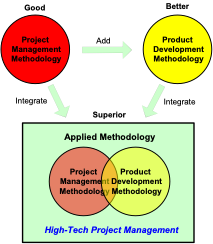
Integrating two methodologies through the project lifecycle giving a synergistic benefit
Immediate benefits of speed and efficiency
Once you create momentum on a project, the team can really feel it. They get a feeling of accomplishment and in general effective teamwork increases. Momentum is especially felt if intermediate milestones are successfully achieved. This is partly the philosophy of the Goal-Directed approach. Monthly milestones create distinct short-term focus. The feeling of positive expectancy increases, and project success becomes a self-fulfilling prophesy.
Usually, project speed comes from design efficiency. This usually is accompanied by:
Effective design reviews and focus on quality at every step
In-team and cross-disciplinary collaboration
Design foresight and problem avoidance
Quick removal of impediments
Appropriate prioritisation of actions
Follow through on key issues
Effective meetings and communications
Effective problem-solving
Reduced need for re-work
Substantial stress reduction
Generally, a combination the above give rise to both harmony and motivation, even though the project might be challenging and at times difficult. There can also be a real feeling of personal growth and team growth. The organisational resource system is alleviated from insoluble resource demands. The feeling of positivity also extends to business development and senior management.
One of the biggest benefits of project speed is felt by the customer or customers in a target segment. Getting products to market on time or ahead of time creates business success for those customers. This improves customer relationships and occasionally creates euphoria.
Business Effects of Capability Improvement
High-tech companies typically improve capability slowly. Sometimes the capability becomes static and stuck. Often, they do not have the mechanisms to improve capability. Such a stagnation in capability will stunt company growth. Typically, the mechanisms which move capability forwards include:
Effective Review Systems and philosophy
Dynamic Project Management System
Advanced and real-time Lessons Learned system
Continuous Improvement
Effective quality management
Knowledge management and advanced project management training
A commitment to master CAE – the tools for design creation and verification
An effective combination of the above is what is required to drive capability forwards at speed. Speed is also accompanied by efficiency.
Most high-tech companies can through a combination of skills training and system establishment improve speed and efficiency by 10% to 20%. What is the positive business effect of this? Let’s say we aim for a 15% improvement. The advantages can be measured in different ways.
We can increase the number of parallel projects by 15%
We can start the next generation of product 15% sooner
Sales can increase by 15%
We can typically improve profitability by around 7%
Cashflow improves
Customers start regarding us as strategic partners in their business, rather than transactional suppliers
We get ahead of the competition and become more attractive
We consume less cost
We can accumulate our asset base in the form of re-usable functions and IP faster
We become predictable with less variance in project duration
We retain staff
Over time, the businesses advantages can simply grow and compound. Why then do high-tech companies get stuck? From my observations over the decades, companies simply believe that projects are inherently difficult and are resigned to that fact that delivery capability cannot improve. It can also be that the management have never experienced a successful project delivery improvement drive. They are not aware of how to improve.
Conclusion
In complex high-tech environments, in terms of “delivery capability” there can be three scenarios:
Scenario 1: The company is permanently stuck at a certain level
Scenario 2: The company learns slowly through project experience
Scenario 3: The company gets trained and introduces superior systems
It first comes down to belief that improvement is possible. Then it comes down to knowing how to improve. Lastly, it comes down to commitment and execution of the improvement drives.
My mission is to move companies down the learning curve at warp speed, that is 10 times faster than natural experiential learning represented by scenario 2.
If you would like to discover how you can move from scenario 1 or 2 to scenario 3, enabling scale-up and growth, feel free to book a consultation session. I can also offer free training: