Mastering the First 10 Days: How Super PMs Rapidly Take Control of New Projects

Starting a new project is one of the most exciting—and high-pressure—moments in any project manager’s career. Whether you’ve been parachuted into an existing initiative or kicking off a new one, the first 10 days are critical. Super Project Managers know this window is where momentum is built, clarity is forged, and leadership is established.
But how exactly do they do it?
They don’t rely on intuition alone. They use structured thinking models, deliberate questioning, and rapid relationship-building to take command of the project landscape.
Ovington’s Window: The Map for Rapid Assimilation and Learning
The first and most dangerous barrier for a new project manager is simple: you don’t know what you don’t know. Worse, veteran team members often aren’t aware of what they do know, leaving a large gap in shared understanding.
This is where Ovington’s Window becomes invaluable. It’s a mental model that maps your knowledge state:
Unconscious Unknows (you don’t know what you don’t know)
Conscious Unknows (you know what you don’t know)
Conscious Knowns (you know what you know)
Unconscious Knowns (you know things automatically, without conscious thought)
Your mission in the first 10 days is to move yourself into the third quadrant—Conscious Knowns—as quickly as possible. This is where clarity lives, and clarity is the fuel of project speed.
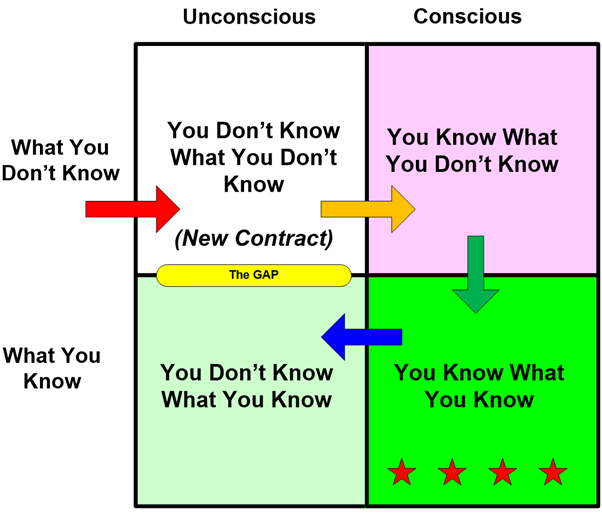
To do this, you must actively seek out the unknowns, surface hidden knowledge in the team, and close gaps in understanding—fast. The number of unknowns should go through a rapid exponential decay function.
How To Take Control of a Project Fast? Ask Better Questions—Faster
So how do Super PMs make this leap in record time? They ask better questions—faster.
Questions are the primary tool for:
Discovery and learning
Building trust and rapport
Motivating and inspiring teams
Negotiation and persuasion
Gaining new perspectives
Solving complex problems
The smartest PMs don’t wait for answers to come to them. They proactively engage stakeholders—starting with their main sponsor or boss, but also deliberately branching out to 5–8 other key individuals across the organization.
They use a variety of question types:
Open-ended questions
Closed questions
Pre-defined questions
Spontaneous, off-the-cuff questions
Generic questions
Highly specific questions
High-level strategic questions
Low-level technical questions
But asking great questions alone isn’t enough. One of the most overlooked accelerators for taking control of a project is the need to overcome the language barrier quickly.
Every project and organization comes with its own internal vocabulary:
Technical Language Acronyms (TLAs)
Industry jargon
Company-specific terms
Project-specific terminology
If you don’t understand these terms fast, you will be on the back foot in every conversation. Smart PMs actively build a glossary in their first few days and make it a point to ask for clarification early and often.
They are also strategic and systematic about their questioning process:
They build a questioning plan.
They track and decode technical language and acronyms.
They listen carefully for what isn’t being said.
They create clarity where ambiguity exists.
Rapid control of a project is about accelerating understanding and building clarity in the project landscape. You can’t lead what you don’t understand. And you can’t influence what you haven’t questioned.
Personal Story: u-blox, Berlin
One of my most enjoyable project management contracts was with ublox, Berlin. I was a hard-working project manager during the week and a tourist at weekends! U-blox developed Wi-Fi and Bluetooth electronic modules for numerous customers. I was replacing a project manager who had been in the post for more than 10 years. There was a lot to learn, with very little time to learn it. The electronics, software and production test engineers were first-class engineers.
This was 2018. I was a seasoned project manager with 30 years project management experience, so I was well used to parachuting into complex and dynamic situations.
The first challenge were acronyms and terms that were very specific to the environment. As was my method, I recorded every term and acronym that I was unfamiliar with. Then I use “interrogation” and study to find out what all of those terms meant. Secondly, I used my generic checklist for rapid familiarisation. I augmented this with targeted questioning to find out what u-blox’s “operating system” was. There were people, departments, products, partners, suppliers, test houses, a project lifecycle model, tools, databases, reporting methods - all of which had to be identified and understood rapidly. The outgoing project manager moved to a different u-blox location in Switzerland.
With an augmented checklist of things to learn and familiarise myself with, I could systematically fill all the gaps in my know-how and understanding. Being structured and systematic works wonders in such situations.
By the end of the 6-month contract I had got two products which were previously languishing in a never-ending development cycle into initial production. This meant sales. All stakeholders were delighted.
Conclusion
The first 10 days of a project set the tone for everything that follows. Super PMs know this window is too important to leave to chance. They deliberately map their knowledge gaps using models like Ovington’s Window, ask high-quality questions, and aggressively work to break through the language barrier to gain full understanding fast.
If you want to lead like a Super PM, start with this mindset: Clarity is speed. Ask better questions. Decode the language. Build better relationships. And take control of your project faster than anyone expects.