Advanced High-Tech Project Management Training: Building Skills and Organisational Capabilities for Sustainable Success
In high-tech industries, project management is rarely straightforward. Complex systems, rapid innovation, and global collaboration mean that a project manager’s role extends far beyond managing timelines and budgets. To thrive in this environment, both individual skills and organisational capabilities must be developed in parallel.
This dual focus is at the heart of our Advanced High-Tech Project Management Training. It equips professionals not just to manage projects, but to lead transformations that deliver sustainable growth. It also allows project managers to accelerate development.
The Two Dimensions of High-Tech Project Mastery
When we look at the demands placed on high-tech project managers today, two dimensions stand out:
Individual Skills – The personal toolkit a project manager develops to navigate challenges, lead teams, and drive results.
Organisational Capabilities – The systems and processes that enable an organisation to learn, adapt, and succeed across multiple projects.
Neglecting one dimension often leads to failure. Highly skilled individuals can’t compensate for broken organisational systems. Conversely, robust processes won’t deliver results if leaders lack communication, decision-making, or resilience.
The goal of our training at High-Tech Project Management is to build strength in both.
By pursuing both paths acceleration can be achieved with:
Personal skills growth
Organisational capability development
Product development
Portfolio expansion
Market growth – number of customers and customer delight
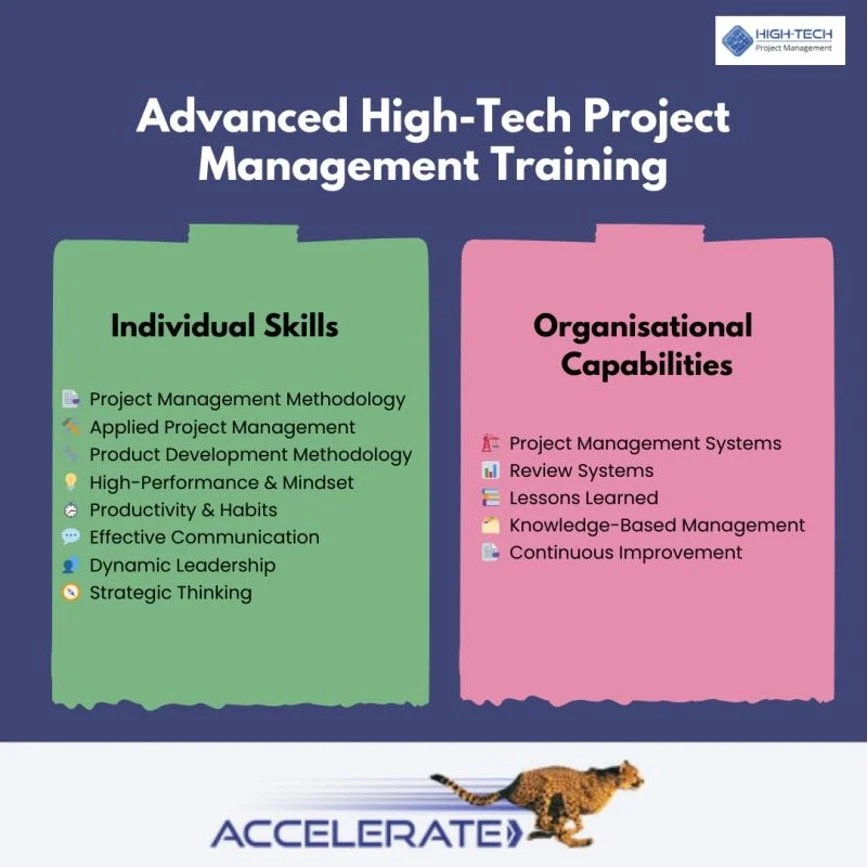
Eight Core Individual Skills
1. Project Management Methodology
At the foundation, PMs must master structured methodologies that align with high-tech complexity. From stage-gate models to hybrid approaches, understanding the “why” behind methodology enables flexible, tailored execution.
2. Applied Project Management
Theory alone isn’t enough. Applied skills ensure PMs can take frameworks and make them work in live projects, adapting to challenges in real time. Applied methodology is dramatically more powerful than pure project methodology.
3. Product Development Methodology
High-tech projects often drive new product creation. PMs must integrate with engineering processes, ensuring development aligns with strategic business outcomes. There must be a drive towards right-first-time development. This requires technical insight and foresight.
4. High-Performance & Mindset
Sustaining performance under pressure requires more than tools. PMs need mental resilience, focus, and the right mindset to lead through uncertainty.
5. Productivity & Habits
Daily efficiency shapes long-term impact. Building sustainable productivity systems ensures PMs can manage workload without burnout.
6. Effective Communication
At the heart of every project is communication, with teams, stakeholders, and executives. High-quality dialogue prevents misunderstandings, accelerates decisions, and builds trust.
7. Dynamic Leadership
Leadership in high-tech is fluid. PMs must flex between directive and collaborative styles, knowing when to inspire, coach, or enforce discipline. The leader must inspire speed and tempo.
8. Strategic Thinking
Beyond immediate tasks, PMs need to see the bigger picture, aligning projects with business strategy and anticipating long-term implications. The PM must be able to devise a way of winning, given the project situation.
Together, these eight skills shape project managers who are not only efficient operators but also strategic leaders.
Five Organisational Capabilities
While individuals drive projects, organisational systems sustain success. Our training highlights four critical capability areas:
1. Project Management Systems
A PMS isn’t just a compliance tool; it can be a profit-making system. When optimised, it accelerates execution, reduces cost, and builds reusability across projects.
2. Review Systems
Learning doesn’t happen by accident. Structured review systems ensure lessons are captured early and used to improve, not just archived. Review systems ensure quality and a reduction in re-work.
3. Lessons Learned
Beyond checklists, lessons must be embedded into culture. Organisations that actively apply past insights build resilience and shorten learning cycles.
4. Knowledge-Based Management
Knowledge is one of the most powerful assets. Capturing and distributing technical, procedural, and strategic knowledge builds competitive advantage across the organisation.
5. Continuous Improvement
This is based on the Japanese principle of Kaizen. Sometimes we over-estimate the improvements that can be achieved short-term, but totally under-estimate the improvements that can be achieved long-term. We can enjoy the journey together, confidently knowing that the only way is up.
Why Differentiation Matters
One of the unique aspects of our training design is differentiation between individual and organisational growth. Many programmes conflate the two, but by splitting them clearly, participants and organisations gain clarity:
Individuals can track personal development across communication, leadership, and productivity.
Organisations can evaluate whether systems are supporting or undermining performance.
This structured approach makes it easier to diagnose weaknesses and prioritise improvements that deliver real impact.
Application in Real-World High-Tech Projects
Consider a semiconductor company launching a new chip design.
Without individual mastery, PMs may drown in complexity and struggle with challenging stakeholder communication, resulting in costly delays.
Without organisational systems, lessons from past design cycles may be lost, leading to repeated mistakes. Continuous improvement won’t happen.
By developing both dimensions, the organisation creates a self-reinforcing loop: skilled leaders using robust systems to drive execution, and systems improving continuously through their feedback.
The Role of Training in Competitive Advantage
In industries where deadlines are tight and innovation cycles short, training isn’t optional, it’s a competitive differentiator. Companies that invest in advanced PM capabilities:
Deliver projects faster and more efficiently
Reduce rework and overspend
Improve employee engagement by reducing burnout
Build long-term organisational resilience
This is the essence of our Accelerate programme.
Conclusion: Building for the Future
The future of high-tech project management belongs to organisations that master both people and process.
By equipping project managers with advanced skills and building organisational systems that sustain performance, companies position themselves for long-term growth and resilience.
Our Advanced High-Tech Project Management Training is designed to deliver exactly that: a dual focus on individual mastery and organisational capability.
Key Takeaway:
True project excellence is achieved when individual skills and organisational systems reinforce one another. Focusing on both is the fastest path to high performance in today’s complex, high-tech environments.
Want to learn more?
Follow us here on LinkedIn and explore our training pathways designed specifically for high-tech industries.
Visit the Escape Campus for our next training and background education: https://escape.company/campus