Stop paying the rework tax: strengthen your Project Management System to handle organisational stress and complexity
Rework is often treated as an unavoidable cost of high-tech product development. It shows up as redesign loops, late defect fixes, repeated integration failures, and frantic release scrambles, and many organisations shrug as if this is simply what complex work looks like. But most of the time, rework is not the price of innovation. It is the price of weak systems.
A stronger Project Management System (PMS) gives teams a way to reduce avoidable iteration, absorb organisational friction, and keep delivery stable even when pressure rises. This article explores how to strengthen the PMS so it does exactly that: reduce the rework tax, improve right-first-time development, and help the organisation cope with stress without descending into chaos.
Why rework is usually a systems failure
When teams talk about rework, they often describe it as if it were a local engineering issue. A design had to be redone. A requirement was misunderstood. A release was incomplete. A supplier component arrived late and forced another verification cycle. All of that is real. But underneath those events, there is often a deeper pattern.
Rework tends to grow when the PMS is too weak in the places where it matters most:
Requirements and architecture are not stabilised early enough.
Review processes are inconsistent or too superficial.
Defects are discovered late, when correction is expensive.
Cross-functional interfaces are unclear.
Organisational stress encourages corner-cutting and reactive decisions.
In other words, the problem is not only that people made mistakes. The problem is that the system allowed predictable mistakes or problem oversights to travel too far downstream.
A stronger PMS treats rework as a design problem. It asks: which recurring defects, misunderstandings, and failure patterns could have been prevented by better process design, better guidance, or better timing? Once you ask that question consistently, rework stops looking like bad luck and starts looking like a solvable systems issue.
What a stronger PMS must do under real-world pressure
A PMS is not just a collection of documents. It is a working system made up of phases, gates, procedures, reviews, checklists, and decision logic. Like any system, it should be designed to meet requirements.
In a high-tech context, those requirements are demanding. A strong PMS should:
Give the project team clear guidance, like a navigation system rather than a static manual.
Reduce generic project risks and recurring organisational stresses.
Support near right-first-time development instead of accepting endless iteration.
Promote a staged review system for all requirements, design and plans, ensuring quality throughout the entire project
Remain structured and hierarchical enough to simplify complexity and give abstraction - extremely easy to navigate
Stay modular and maintainable so it can evolve without becoming bureaucracy.
Define clear business, project, and technical objectives for each phase.
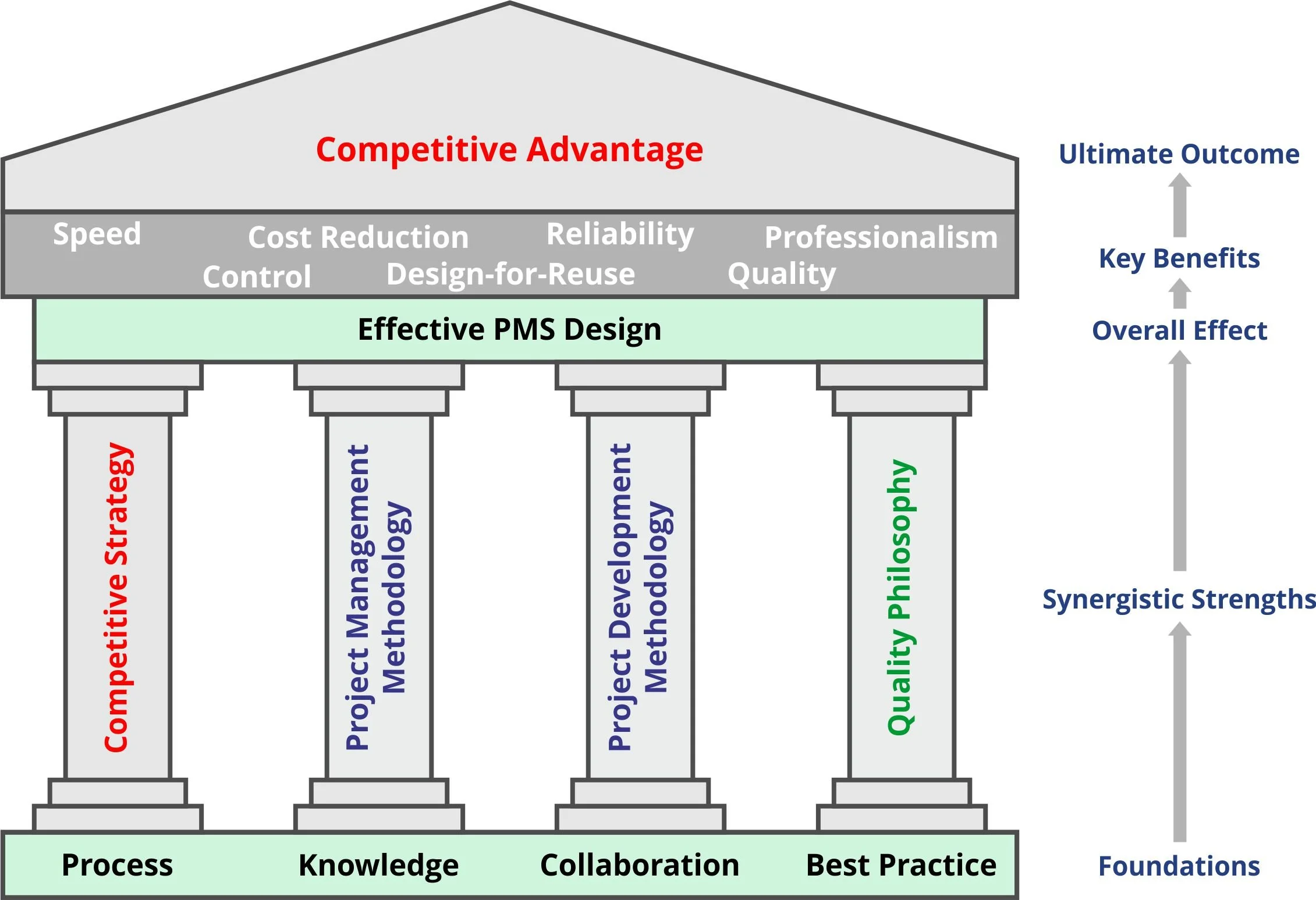
The highest level goals of a PMS should be to facilitate speed, encourage foresight, facilitate concurrent engineering and reduce cost. The designers and maintainers of a PMS should be able to articulate how those goals are met.
This matters because organisational stress is not an exception in high-tech work. It is the operating environment. Projects run under market pressure, technical uncertainty, resource scarcity, supplier dependencies, and internal politics. A PMS that works only when conditions are calm is not really a PMS; it is a fair-weather process map.
The real test is whether the system still helps when schedules tighten, tempers shorten, and ambiguity rises.
Build upstream quality into the system
One of the most effective ways to reduce rework is to strengthen the PMS upstream, before defects and misunderstandings become embedded.
Clarify before you commit
Many expensive downstream problems begin with weak early work products: fuzzy market requirements, incomplete system specifications, rushed architectural choices, or assumptions that were never properly challenged. Once those weaknesses pass through gates unchecked, they contaminate the rest of the project. Problems propagate and amplify.
A stronger PMS therefore gives much more weight to upstream quality control. It builds in:
Better requirement definition and review
Stronger system and architecture thinking early in the lifecycle
Explicit feasibility and risk checks before major commitments
Top-down guidance for both overall system development and discipline-level work
This is not about slowing projects down. It is about preventing the far greater delay of discovering, halfway through execution, that the foundations were not strong enough.
Strengthen review quality, not just review quantity
Many organisations have plenty of reviews, yet still suffer from heavy rework. The issue is not the number of review meetings. It is whether those reviews are designed to catch the right weaknesses at the right time.
A resilient PMS uses review processes to detect defects early, especially in work products that shape everything else: requirements, architecture, integration strategies, verification approaches, and release readiness. It also makes expectations visible. Teams know what “good enough to proceed” actually means, rather than relying on vague confidence.
Use checklists and guidelines intelligently
Checklists are often dismissed as administrative clutter, but good checklists reduce preventable error. The key is to use them as thinking aids, not bureaucratic burdens. A well-designed PMS includes checklists and guidelines that help teams verify completeness and quality before advancing design work, documentation, release packages, and critical decisions.
When used properly, these tools reduce oversight, create consistency, and support right-first-time behaviour across functions.
Reduce iteration by finding defects earlier
The later a defect is found, the more expensive it becomes to fix. That is one of the oldest truths in engineering and product development, and yet many organisations still tolerate PMS designs that push defect discovery far too late.
Excessive iteration damages delivery in several ways:
Teams revisit earlier phases, disrupting schedules and focus.
Costs escalate because more resources are consumed on correction rather than progress.
Product coherence suffers when repeated changes ripple unevenly through the system.
Stress rises, which often leads to even more defects through fatigue and corner-cutting.
A stronger PMS interrupts that loop by shifting detection and prevention left. In practice, that means:
Clearer verification intent from the start
Better defect tracking and earlier visibility of inconsistencies
Review points that challenge assumptions before detailed execution runs too far
Greater alignment between project management processes and product development processes
This is where the PMS becomes more than a governance device. It becomes an engine for delivery stability.
Design the PMS to absorb organisational stress
Rework is rarely driven by technical issues alone. Organisational stresses often act as multipliers.
In high-tech settings, common stress factors include:
Rapid market shifts and customer urgency
Internal inefficiencies and resource constraints
Weak communication across teams and functions
Siloed engineering effort that makes integration painful
Recurring malfunctions in the way planning, decision-making, or release preparation are handled
Client-specific customisation or over-specification that quietly explodes complexity
A PMS should be designed to handle these realities directly rather than pretending they are external to process design.
Create clarity under pressure
When stress rises, ambiguity becomes dangerous. A strong PMS provides clear procedural frameworks so teams know how to move from planning to execution to release even when the environment is tense. It reduces the need for constant reinvention because the core path is visible.
Focus process strength where the pain is greatest
Not all organisations suffer in the same places. For some, quality is the recurring pain point. For others, the main issue is speed, decision latency, or release chaos. A better PMS adapts its emphasis to the stress profile of the business.
If quality failures are frequent, quality assurance and verification logic need to be strengthened. If speed is the commercial priority, the PMS should create more clarity, better flow, and fewer avoidable loops. If excessive customisation is destabilising the portfolio, the system should control variation more deliberately.
This is how the PMS becomes organisationally stress-aware rather than generic.
Strengthen the whole system, not just the PM layer
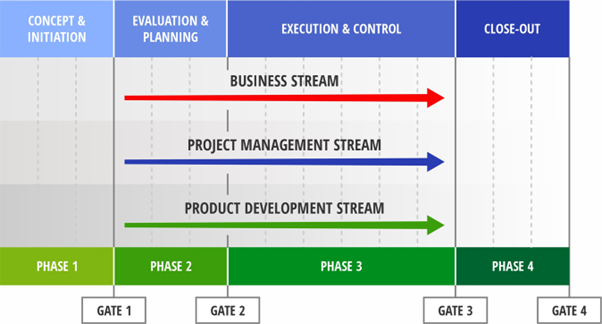
One of the strongest ideas in the broader HTPM framework is that a world-class PMS integrates three process streams:
Business processes
Project management processes
Product development processes
Rework often flourishes when these streams are misaligned. A business promise is made without enough project realism. A project plan advances without product-development constraints being properly understood. An engineering team optimises locally while the broader project system remains unstable.
Strengthening the PMS therefore means designing across all three layers. It means asking:
Are strategic and commercial decisions setting projects up for success or for stress?
Do project management processes give enough structure, visibility, and control?
Are product development processes robust enough to support right-first-time engineering?
When those streams work together, the organisation makes fewer self-inflicted errors.
Make the PMS dynamic: learn, update, improve
A strong PMS is not static. It evolves through accumulated experience.
Every project contains learning points: rework patterns, risk events, release problems, supplier issues, review misses, and coordination breakdowns. The mistake many organisations make is to treat lessons learned as an end-of-project ritual instead of as fuel for system improvement.
A dynamic PMS changes that. It makes the upgrade process easy and expected. It treats each project as a source of design input for the next version of the system.
Practical moves include:
Feeding recurring issues back into procedures, reviews, and checklists
Updating modules without overhauling the whole PMS
Using continuous improvement and lessons-learned loops throughout the lifecycle, not just at close-out
Embedding design-for-reuse thinking so that knowledge, assets, and good methods accumulate instead of evaporate
This is how a PMS becomes a competitive asset. It does not merely document current practice; it helps improve future practice.
Conclusion
Rework is not just an irritation on the edge of delivery. In most high-tech organisations, it is a signal that the PMS is not strong enough where pressure, ambiguity, and complexity hit hardest. When you build upstream quality, detect defects earlier, design the system to absorb organisational stress, and keep the PMS dynamic through real learning, teams spend less time looping backwards and more time moving forward. That shift is powerful because it improves cost, schedule, quality, and resilience at the same time. Stop paying the rework tax, and your PMS starts doing what it should have been doing all along: helping the organisation deliver with clarity and stability under pressure.