Getting the foundations right in a high-tech project set-up

In high-tech environments, success doesn't start with execution—it starts with set-up. A project built on a shaky foundation will struggle to deliver, regardless of how talented the team or how advanced the tools. That's why the project set-up phase isn’t just a box to tick—it’s the single most critical phase for long-term delivery success.
From defining scope to clarifying requirements, the early weeks of a project create the scaffolding for everything that follows. When project managers skip these steps or rush through them, they find themselves constantly firefighting later. But when set-up is done right, it prevents chaos, aligns expectations, and enables smarter decisions at every stage.
The four parameters that define every project
No matter the technology or market, every project is shaped by four key parameters:
Scope
Schedule
Cost
Quality
At the beginning of a project, one or more of these will be seen as non-negotiable—whether by a customer, a business sponsor, or an internal stakeholder. Your job as the project manager is to find out which ones. Some constraints are flexible. Others aren’t. And assumptions are dangerous.
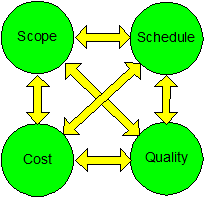
Note that the four parameters are often in contention - they fight against each other. Increasing scope puts pressure on cost and schedule.
That’s why early discovery is essential. Ask effective questions. Investigate expectations, not just what’s documented but what’s implied. Then use tools like the Project Optimisation Matrix (POM) from the Project Diagnosis framework to visualise trade-offs and drive focused planning discussions. The POM should be used to define the project strategy, which precedes the project planning. A POM gives great direction to the project. Note, however, that the emphasis and relative importance during the project can shift during the project. Ideally, this shift should be formally agreed with stakeholders, then the strategy and plan should be adjusted. This will be a new pathway to project success.
Early identification of key constraints helps you size up the project effectively and determine where your focus must lie during the setup phase.
Why requirements definition is an ongoing process
A solid Requirements Definition is the cornerstone of product and project alignment—but don’t mistake it for a one-time deliverable. Requirements evolve. New information emerges. Priorities can shift.
It is also important to realise that customer or market requirements can be a sub-set of system requirements. Often domain experts and in-house engineers need to analyse the design in order to make it robust or resistant to failure under all operating modes and conditions. This is not something that users cannot achieve. In general, Design-for-eXcellence (DfX) needs to be considered up-front.
Your first task as PM is to understand the current state of the requirements. In some cases, you’ll be working from a clear customer ITT (invitation to tender). In others, you’ll need to balance external needs with internal ambitions and requirements for product robustness. Either way, the quality and completeness of your requirements will determine everything from architecture decisions to feasibility.
Here’s what high-performing PMs do:
Use an internal structure or template for system requirements, drawn from proven project examples.
Identify gaps and unclear items early—don’t wait for reviews to find out something’s missing.
Flag feasibility concerns before they become showstoppers.
Drive discussions with customers and internal stakeholders to negotiate changes and clarify trade-offs.
And importantly, treat requirements management as a process, not a phase. Throughout the project lifecycle, changes to requirements must be managed via proper change control, especially where they impact cost, schedule, or deliverables.
The benefits of initial project definition documents
In the set-up phase of the project, some key documents can act as a foundation for project success. In particular, the following can be crucial:
The Project Initiation Document (PID) - clearly defines the project scope, objectives, resources, key risks, assumptions and responsibilities. It is the blueprint for your project’s success.
Statement of Work (SoW) - A high level description of the scope of the work to be done, responsibilities between parties and deliverables. This is great for defining who does what when two or more parties are involved. Note that, an internal version of this can be derived from the external one, if there are several additional internal deliverable.
System Design Specification (SDS) - for complex systems this document can be very useful, it can include or reflect system requirements to make the product reliable and robust under all conditions. Some high-level representation of the design or architecture might be included. This gives guidance to the next stage of design - the mid-level.
When done properly, these document answers the most fundamental questions about your project:
What are we doing and why?
What benefits is the project meant to deliver?
What’s the background and business context?
What’s in and out of scope?
What are the key constraints, deliverables, and interfaces?
Who’s responsible for what?
What are all the deliverables?
What are the reporting and escalation structures?
If this document is missing—or vague—expect ambiguity, misalignment, and friction later. On the other hand, a strong PID becomes your go-to reference point for aligning stakeholders, managing scope creep, and guiding decision-making.
It also plays a foundational role in downstream planning: informing the Statement of Work, the Work Breakdown Structure, and even your quality and risk management approaches.
Conclusion
When it comes to high-tech project delivery, great execution doesn’t make up for poor set-up. The most effective project managers don’t just launch into activity—they pause, probe, and build a solid foundation first.
Should a project manager be assigned to a new project during the execution phase, it is essential to check the robustness of the project foundations as quickly as possible. Remedial effort may be required.
Understanding your four key parameters, managing evolving requirements with intent, and anchoring everything in a clear Project Definition Document are not just setup tasks—they are strategic moves that define the trajectory of your project.
Neglect the foundation, and you’ll build on sand. Get it right, and you set the stage for reliable, high-quality delivery.
Need the Super Project Manager Ebook?
See: https://high-techprojectmanagement.com/ebook/