Navigating Around Communication Barriers
A precursor to achieving excellence in communication is to understand communication barriers. In complex and fast-moving high-tech companies there are more communication barriers to overcome than we anticipate. On the other hand, without overcoming barriers collaboration is difficult to achieve. It is through collaboration that business objectives are met.
We will be addressing excellence in communication in an imminent article, but it is important to highlight that a key reason that in high-tech companies we need speed. In particular, we need speed of:
Attention
Engagement and understanding
Problem identification and understanding
Response and action
Coordination and ongoing collaboration
New product development
A useful way of visualising a complex object, while considering communication barriers is the graphic below. It resembles an obstacle course. In order to achieve a complex objective, we need to identify communication barriers with those we need to collaborate with, then we need to fathom out how to get through or navigate around communication barriers.
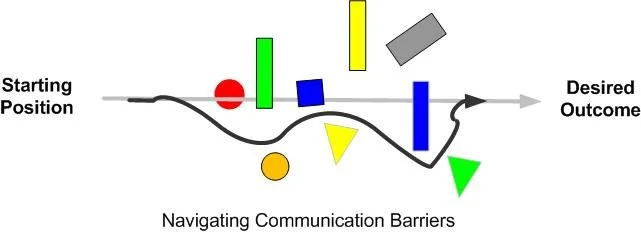
Let’s first understand the barriers we may come across.
Understanding Communication Barriers
The communication process can be depicted by a model. This is shown below.
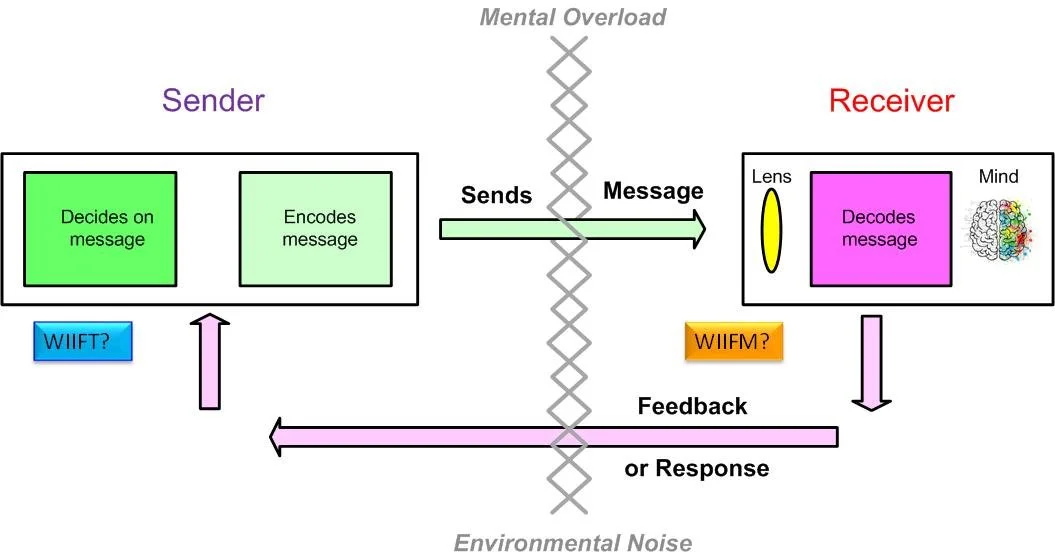
The communication process model shows us how difficult effective communication can be in a high-tech environment. We of course have a message as sender (us) and there is an intended message receiver (them). We wish to convey a message with an intended outcome. The outcome could be to understand, be persuaded, to give information, to take an action or to advise, for example.
In high-tech environments we are all flooded with streams of new information. Thus, we invariably have a situation of environmental noise. Coupled with that is the fact that the message recipient is most probably experiencing a mental overload – a myriad of complex problems and challenges. Somehow, we need to get our message through this noise barrier. The message needs to be high quality, that is, well-crafted and well-delivered.
Looking at the process, we may have a lot to say, but to be effective we have to decide on a key, central message. Then we need to craft and encode the message. That means design the structure, the logic, the appeal and select the mode the message will be transmitted. In designing the message, we must determine, “What’s in it for them?”, or WIIFT. Why should they pay attention to your message? We can then send the message.
The recipient of the message, who of course, is potentially overloaded with information and existing challenges, is trying to evaluate, “What’s in it for me?”, or WIIFM. There is a risk that the receiver ignores or does not really decode the meaning or significance of the message. Your message may be perceived as noise or an “inconvenience”.
When communication is upwards or across organisational departments, there are often natural barriers. For high-tech project managers these fall into a category of challenges, which we call “supranormal challenges”. These are challenges outside the defined scope of the project. The receiver of your message may have any of the following barriers, which might be used to filter out what you are trying to tell them. For example:
Different career experience and path might focus on a different set of problems
Attitude problem – you have a job responsibility, so you should solve it
Prejudices and beliefs
Values – what is important to them
Lack of interest
Siloed thinking and lack of collective responsibility
Lack of understanding due to technical complexity
Communication style preference based on personality type
Politics
Let’s assume we are a project manager. Some examples of the above could be:
Case 1: You want the group leaders of electronic engineering and mechanical engineering to collaborate such that concurrent engineering can work. The organisation has a weak matrix structure, and the functional leads might take the attitude that you should just report on project progress – an attitude issue.
Case 2: In an attempt to maximise sales, the Business Development Manager has defined a product with 6 variants, so that he can sell the product to as many customers as possible. This unfortunately increases the total design, verification and validation effort by 150%. Market release would be delayed by 10 months. You approach him to rationalise the product definition. The BDM does not understand why engineering need so much effort, and initially dismisses your appeal.
Case 3: As a project manager, you see opportunities to improve the lessons learned process. Management is not convinced and do not see any business benefits. Your communication approach lacks structure and your arguments are unconvincing. The idea is dismissed and ignored.
The last case, Case 3, highlights an interesting point. We all have different personalities and values. Broadly speaking, personalities can be categorised. There are many personality profiling systems available. The one I have used since around 2006 is the DISC profiling system. I learnt it and it seemed to make sense. I adopted it into my working environment and found that the model really works. An important aspect of DISC profiling is understanding our own preferred style of communication versus the preferred style of others.
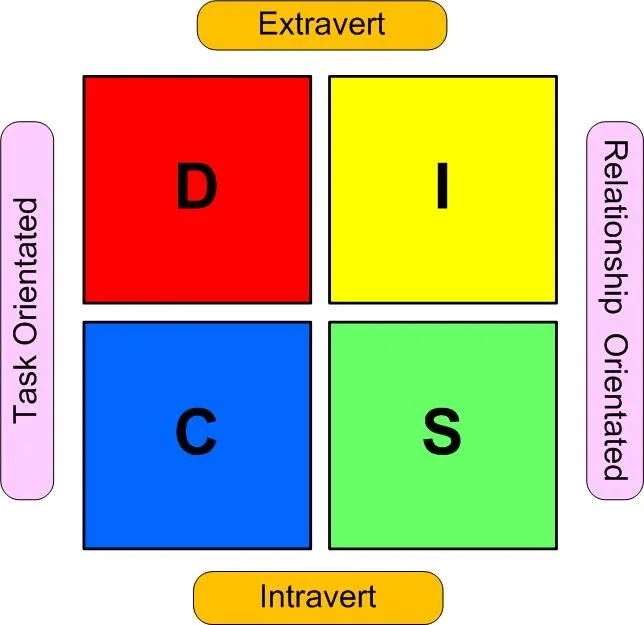
The 4 basic personality styles and behavioural types are depicted by the four letters. In an alternative representation the categories are represented by colours. This is the case in Thomas Eriksons bestseller, “surrounded by idiots – The Four Types of Human Behaviour and How to Effectively Communicate with Each”. There are two axes to a map. The x-axis represents Task Orientated versus Relationship Orientated. The y-axis represents Extraversion vs Intraversion.
In broad terms, the main characteristics in DISC profiling are:
D: Dominant and decisive
I: Inspiration and connection
S: Supportive and steady
C: Logical, factual and detailed
Let’s expound these traits in the form of a table:
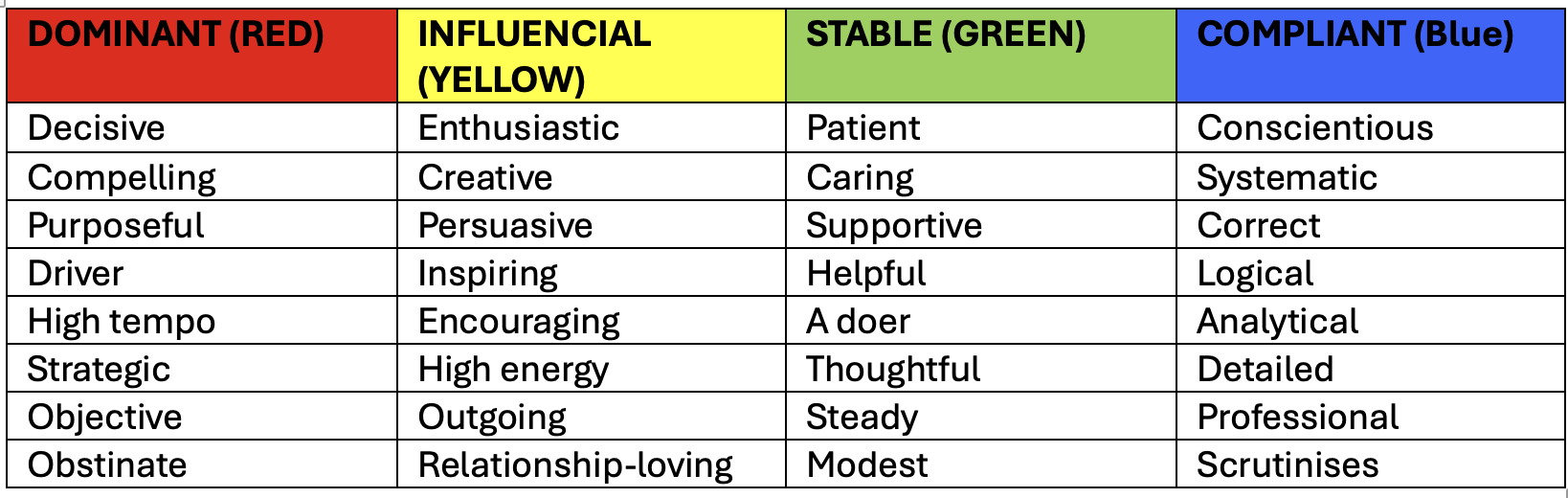
You probably get the flavour! In the DISC profiling system, we take a personality test based on preferences. We get graded as a dominant and a secondary style. When I first took the test 20 years ago, I came out as a D/C. As an Engineering Programme Manager, that seemed to fit. My wife, who was an Occupational Therapist, came out as a S/C. This also seemed to fit.
The preliminary important thing to realise is what others value and prefer and how we are perceived by others. I would historically give very logical, factual and detailed presentations. In communication, we often need to adjust our communication style appropriately. My style would not appeal to an ‘I’ type colleague. If we communicate in a way that does not appeal to the recipient or audience, that is a barrier. Senior managers, often have a ‘D’ preference, sales staff have and ‘I’ preference, engineers a ‘C’ preference and operational staff an ‘S’ preference. The important thing is to realise that our own, natural style and emphasis in communication is probably not suitable for other individuals.
Thus, if we make a proposal to management, we need to present an executive summary, get to the point and express outcomes in business-related terms. If we want to influence sales, we may need to rev-up the enthusiasm and personal touch. If we are persuading a group of engineers, we will need logic, facts and supporting detail. In the basic communications process model, the lens at the front end of the receiving side depicts communication preference and values. In order to get our message through, we may need to craft then deliver the message in a certain way.
Some Key Principle Surrounding Communication Challenges
You may find that following a few principles helpful in your campaigns to communicate effectively. I will number these.
Principle 1: “The effectiveness of your communication is represented by the response you get”
This relates back to the communications process model we initially showed. Unless we actually get a positive reply of action, then we do not know if or how the message was received. We can never assume that just transmitting a message is a message effectively received.
Principle 2A: “The single biggest problem in communication is the illusion that it has taken place” – a quote by George Bernard Shaw
Often, we imagine that we have communicated, but actually we have not. “Surely they know this already”, is an assumption that often in not true.
Principle 2B: “Telepathy does not work in project management”, is my own quote and is actually similar to Shaw’s quote, but it is applied the field of project management. This means that we need to become ever more mindful of explaining what we think.
Principle 2C: “You cannot not communicate”, again is my own quote or principle.
This reminds us that we should always be mindful of when we should communicate. Sometime, in the fast flow of business we forget to communicate. Examples might be:
The email we should acknowledge and state that we will get back next week
The thanks for the good work just completed
The new strategy and plan for approaching product release
This issue is that when we forget to communicate, potential recipients will put an interpretation on your non-communication, and that interpretation is often negative! So if we forget to communicate, we are communicating anyway, but in the wrong way.
Principle 2A, 2B and 2C are actually closely related, but they all remind of the importance of actually communicating.
Principle 3: “The map is not the territory”, is a principle coined by Alfred Korzybski, meaning
our mental models, beliefs, or representations of reality (the map) are not the same as reality itself (the territory).
What we should be aware of:
Subjective Perspectives: Our "map" of the world is based on personal experiences, filtering, and interpretations, not objective reality itself.
Mistaking Map for Territory: This fallacy occurs when someone acts as if their model of the world is perfect reality, leading to bad decisions.
In Communication: A person’s mental model of a situation (their perspective) is not the objective reality, leading to conflicts when individuals hold different "maps".

This is a powerful analogy. A map of a country, like Iceland, is just a representation of the actual territory. It can show different things like roads, regions, altitude or ground type.
Likewise, different people perceive a business or a project situation differently. We each have a natural bias, and our familiarity with issues may differ.
Be aware of this in order to help improve your emotional intelligence. This will reduce conflict arising from different perceptions. It should lead to more constructive discussion in order to reach alignment, resolution or compromise
Embedding some of these key principles into your way of thinking will help you identify barriers to communication success. Knowing where barriers may lie, paves the way for more effective communication.
Building the Foundations for Successful Communication
We have looked at the first steps for successful communication – understanding and anticipating the barriers, then to understand some key principles. The next step in paving the way forward is to build some foundations. We can review three initiatives – using empathy, using emotional intelligence and using relationship engineering.
1. Using Empathy
Developing empathy allows us to discover the other party’s map of the world and of the situation in question. We need to pre-empt where they are. Subsequently, we require some dialogue and discussion. We need to have empathy in order to:
Understand their perspective
Understand how they feel
Have effective discussion and dialogue
Understand cognitive distortions
Understand where they are now and where you need them to be
Understand their stresses
Appreciate fatigue and overload signs
Manage their focus, if necessary
However, with colleagues we should also expect professionalism and commitment. Demonstrating an empathetic nature, builds trust and cooperation. Empathy helps to overcome some barriers.

2. Using Emotional Intelligence
In high-tech companies, many individuals have a high IQ. This tends to mean that staff rely on logic. However, emotional intelligence, which is often graded as EQ (Emotional Quotient), is important for getting along with people. This is important for creating collaboration, teamwork and synergy.
If you describe a person as empathetic and self-reflective, that person is most likely emotionally intelligent. They are empathetic because they understand and share the feelings of others, and they are self-reflective because they are aware of and can manage their own emotions.
Emotionally intelligent people are able to interpret both their own feelings, and the feelings of others, and then take one step further to understand them in context. They are unlikely to lose control and express extreme emotions in public, as they are skilled at managing their impulses and have strong social skills.
By balancing facts and intuition, they appear authentic. They are also extremely adaptable because they directly perceive moods as signals and change their communication accordingly. This ability ensures that emotionally intelligent people are persuasive in their communication. Emotionally intelligent people can greatly influence others because they know how to speak to their specific emotional triggers. This shows they really understand what others are feeling and need.
Emotional intelligence will help you:
Be open to opposing points of view
Resolve conflicts on an equal footing
Communicate more authentically
Build stronger relationships
Stay curious about other opinions
Recognize moods in a room
Interpret signals on an emotional level
Trust your intuition in various situations
3. Using Relationship Engineering
We have discussed this important topic in an earlier newsletter article (27th February, 2026).
Creating a relationship with an individual is often a specifically, unique challenge. It is through skilful communication that relationships are created. In particular, we need empathy and emotional intelligence. We need to see the world from the other person’s perspective.
Relationships need to be initiated, and then they need to be nurtured. What we are seeking primarily is the ability to collaborate. We can take a lesson from marketing and social media here. Who do we pay attention to is a noisy, stressful environment? It is people we know, like and trust (often depicted by the acronym, KLT). I might add to that, to understand (or KLT-U), which is particularly true in a knowledge-based organisation.
The key issue is that the KLT-U criteria should really be achieved before effective communication can take place. If you are approaching a key person in an organisation to negotiate, persuade or to solve a complex problem, then having established an effective working relationship first, helps enormously.
This means that super project managers or super business leaders need to think about relationship development strategically, and then to work on it systematically or tactically. We can think of this endeavour as “relationship engineering” – success by design followed by skilful implementation.
Conclusion
In this article we have highlighted the importance of understanding communication barriers. Understanding our challenges helps us address them in the most effective manner.
In high-tech organisations we experience great pressure, complex information flows and differences in perspectives. We can only achieve great things through cooperation and collaboration. Therefore communication skills are highly valued.
We have considered a range of communication barriers, looked at some key guiding principles and outlined how we can establish a good foundation for collaboration.
In forthcoming articles we will also look into:
Excellent communication skills for normal situations
Advanced communication skills for contentious situations
Should you need a broader understanding of super communications skills, then do not hesitate to reach out. I am very approachable 😊.